
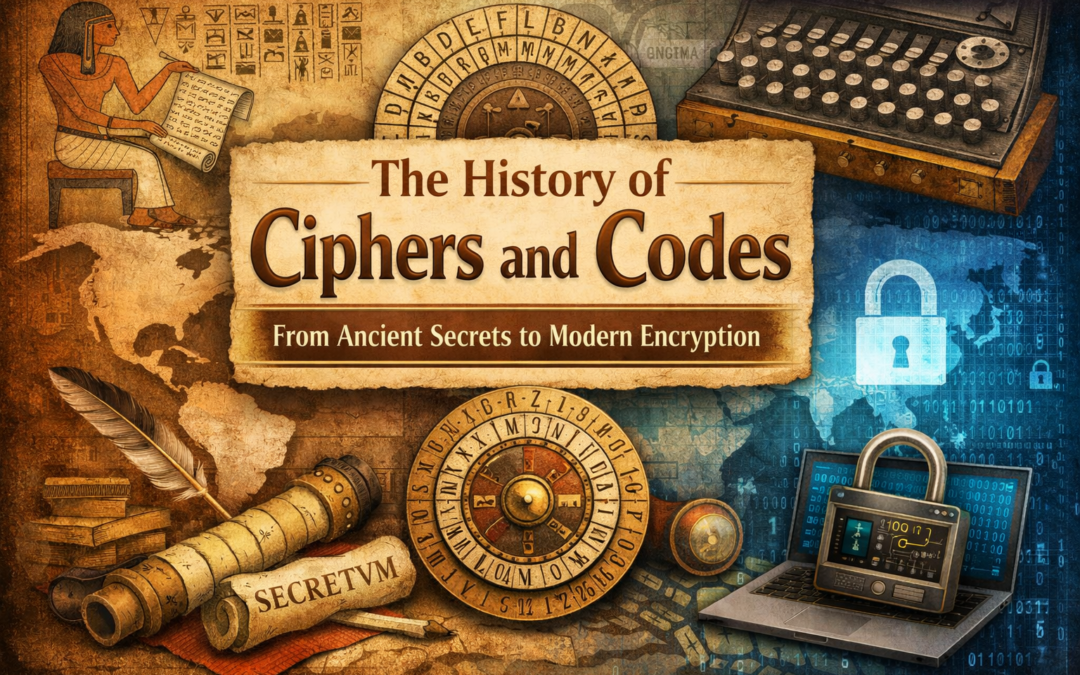
From Ancient Secrets to Modern Encryption
Before the internet, before telephones, even before the printing press, humans faced a fundamental challenge: how do you communicate something important without your enemies understanding it?
The answer lies in the fascinating history of ciphers and codes—a story that spans millennia and touches every major conflict, political intrigue, and technological revolution in human history. From Spartan warriors wrapping leather strips around wooden rods to modern governments deploying quantum-resistant encryption, the art of secret writing has shaped the course of civilization.
Understanding this history isn't just an academic exercise. It reveals the timeless principles of security, the constant arms race between secrecy and discovery, and the ingenious methods humans have developed to protect their most valuable asset: information. Whether you're a student of history, a technology enthusiast, or simply curious about how secrets have been kept throughout the ages, this journey through cryptographic history will illuminate the hidden war between plaintext and silence.
The Dawn of Secret Writing: Ancient Ciphers
The earliest known ciphers emerged when writing itself was still relatively new. Ancient civilizations quickly recognized that the power of written communication came with a serious vulnerability—anyone who could read might intercept your message.
The Spartans, renowned for their military discipline and efficiency, developed one of the first practical cipher devices around the 5th century BCE. The scytale was elegantly simple: a strip of parchment wrapped around a wooden rod of specific diameter. The sender would write their message along the length of the rod, then unwrap the parchment. To anyone intercepting it, the letters appeared as meaningless jumble. Only someone possessing a rod of identical thickness could rewrap the parchment and read the message correctly.
This device introduced a principle that remains relevant today: security can be mechanical, not just linguistic. The scytale was a transposition cipher—it didn't change the letters themselves, but rearranged their order according to a specific pattern determined by the rod's dimensions.
Several centuries later, Julius Caesar employed a different approach. The Caesar Cipher, as it came to be known, used substitution rather than transposition. Each letter in the message was shifted a fixed number of positions in the alphabet. If you shifted by three positions, A became D, B became E, and so forth. The word "DEFEND" would become "GHIHQG."
While incredibly simple by modern standards—there are only 25 possible shifts to try—the Caesar Cipher was effective in an era when literacy itself was rare, and cryptanalysis didn't yet exist as a discipline. It demonstrates another enduring principle: in battlefield conditions, simplicity often wins. A cipher that's too complex for your own soldiers to use reliably is worse than no cipher at all.
Medieval Innovation: The Birth of Cryptanalysis
As ciphers evolved, so did the methods to break them. The medieval period saw significant advances on both sides of this equation.
Monoalphabetic substitution ciphers became popular throughout Europe and the Middle East. Unlike the Caesar Cipher's simple shift, these used a completely randomized substitution alphabet. A might become Q, B might become M, C might become T, with no obvious pattern connecting them. This dramatically increased the key space—the number of possible variations—making brute force attempts impractical.
However, these ciphers contained a fatal flaw that Arab mathematician Al-Kindi identified in the 9th century. He developed frequency analysis, recognizing that certain letters appear more often than others in any given language. In English, for example, E is the most common letter, followed by T, A, O, and so on. By analyzing which symbols appeared most frequently in an encrypted message, a skilled cryptanalyst could begin mapping the substitution alphabet.
This breakthrough marked the birth of cryptanalysis as a formal discipline. The moment ciphers existed, codebreakers followed. It's a pattern that has repeated throughout history—every new method of encryption eventually faces someone determined to break it.
The Vigenère Cipher, developed in the 16th century, represented the next major evolution. Instead of using a single substitution alphabet, it used multiple alphabets in sequence, selected by a keyword. If your keyword was "LEMON," you would shift the first letter according to L's position, the second according to E's position, and so on, repeating the keyword as needed.
This polyalphabetic approach defeated simple frequency analysis, earning the Vigenère Cipher the reputation of being "le chiffre indéchiffrable"—the indecipherable cipher. It remained unbroken for centuries, demonstrating an important principle: pattern repetition creates vulnerability. The Vigenère Cipher's eventual weakness was discovered when cryptanalysts realized that the repeating keyword created statistical patterns that could be exploited.
The Mechanical Age: Industrialized Secrecy
The Industrial Revolution transformed cryptography from an artisan craft into an industrial process. The most famous example is the Enigma machine, used extensively by Nazi Germany during World War II.
Enigma was a marvel of mechanical engineering. Each time an operator pressed a key, electrical current passed through a series of rotating rotors, each wired differently. After encrypting one letter, the rotors advanced, changing the wiring configuration. Press A once, and it might encrypt as G. Press A again immediately, and it might encrypt as X. Press it a third time, and you might get T.
This dynamic substitution made Enigma extraordinarily difficult to break. The number of possible configurations was astronomical—billions of potential settings. Yet it was broken, primarily through the work of mathematicians and engineers at Bletchley Park, including Alan Turing. The breakthrough didn't come from mathematical genius alone, but from recognizing human patterns. German operators often used predictable phrases, repeated common words, and occasionally made procedural mistakes. These habits provided the foothold codebreakers needed.
The breaking of Enigma is estimated to have shortened World War II by several years and saved countless lives. It also marked a turning point: cryptography became computational. Breaking codes was no longer about linguistic insight alone—it required machines to fight machines.
During this same era, another cipher achieved theoretical perfection: the one-time pad. The concept is elegant. Generate a truly random key that's exactly as long as your message. Use each key symbol to encrypt one message symbol, never reusing any part of the key. If implemented correctly, this cipher is mathematically unbreakable.
Cold War spies extensively used one-time pads, often encoded on tiny strips of paper hidden in dead drops or on microdots attached to legitimate correspondence. The cipher's perfect security came with a significant practical challenge: key distribution. Both sender and receiver needed identical copies of the key, and keys could never be reused. In practice, humans failed—keys were reused, randomness wasn't truly random, and operational security broke down.
The Digital Revolution: Modern Cryptography
The advent of computers transformed cryptography yet again. In the 1970s, IBM developed the Data Encryption Standard (DES), which was adopted by the U.S. government. DES used a 56-bit key, which seemed secure at the time. However, as computing power increased exponentially, that security eroded. By 1998, DES was publicly cracked in under three days.
This introduced a critical lesson: security is relative to computational power. What seems unbreakable today may be trivial to crack tomorrow.
The current gold standard is the Advanced Encryption Standard (AES), which uses key sizes of 128, 192, or 256 bits. AES-256, in particular, is used throughout the modern digital infrastructure—in government systems, banking, VPNs, and secure messaging applications. Brute-forcing AES-256 is computationally infeasible with current technology. Even if you could check a trillion trillion keys per second, it would take longer than the age of the universe to try them all.
Perhaps the most revolutionary development in modern cryptography came with public key encryption, particularly the RSA algorithm. Previous ciphers were symmetric—the same key encrypted and decrypted the message. This created the eternal problem of key distribution: how do you securely share the key with your intended recipient without an adversary intercepting it?
Public key cryptography solved this elegantly by using two mathematically related keys. One key is public and can be shared openly. The other is private and never leaves your possession. Messages encrypted with the public key can only be decrypted with the private key. This system relies on the mathematical difficulty of factoring large prime numbers—a task that remains computationally prohibitive.
However, the emergence of quantum computing threatens to upend this security. Quantum computers could theoretically factor large primes efficiently using Shor's Algorithm, which would collapse modern internet security. This has spurred the development of post-quantum cryptography—new systems based on mathematical problems that even quantum computers struggle to solve, such as lattice problems and hash-based signatures.
Understanding the Distinction: Ciphers vs. Codes
Throughout this history, it's important to understand the distinction between ciphers and codes, terms often used interchangeably but technically different.
A cipher operates at the level of individual letters or symbols. It transforms the message systematically using a key or algorithm. Whether it's the Caesar Cipher shifting letters or AES performing complex mathematical operations, ciphers work on the components of the message.
A code, by contrast, replaces entire words or phrases with predetermined substitutes. If "APPLE" means "ATTACK AT DAWN" in your codebook, that's a code, not a cipher. Codes require both parties to possess the same codebook, which creates security challenges but also provides additional layers of protection.
Professional intelligence operations often use both together—encoding a message first, then enciphering it. This layered approach exemplifies a fundamental principle of security: defense in depth. No single method is perfect, but multiple layers make an adversary's task exponentially more difficult.
The Continuing Evolution
The history of ciphers and codes isn't finished—it's an ongoing story that continues to unfold. Elliptic Curve Cryptography (ECC) now provides the same security as RSA with much smaller keys, making it ideal for mobile devices and systems with limited computational resources. Homomorphic encryption promises the ability to perform calculations on encrypted data without ever decrypting it. Blockchain technology applies cryptographic principles to create distributed trust systems.
Each advancement carries forward lessons learned across millennia. The Spartan scytale taught us that security can be mechanical. The Caesar Cipher showed us the value of simplicity. Al-Kindi's frequency analysis reminded us that patterns are vulnerabilities. Enigma demonstrated that human factors matter as much as mathematical strength. The one-time pad proved that theoretical perfection often fails in practice. And modern cryptography continues to balance security, usability, and computational efficiency.
The Enduring Principles
What can we learn from this sweeping history? Several principles emerge clearly.
First, security is a moving target. What protects your secrets today may be trivial to break tomorrow. The cipher that takes decades to crack becomes vulnerable when computational power increases or new mathematical techniques emerge.
Second, humans remain the weakest link. Enigma's mathematical strength couldn't overcome operator habits and procedural failures. One-time pads' perfect security crumbled when people reused keys. Modern systems face similar challenges—strong encryption means nothing if users choose weak passwords or fall for phishing attacks.
Third, the arms race never ends. Every cipher eventually faces someone trying to break it. The question isn't whether your system is unbreakable, but how long it will take to break. That margin of time—seconds, hours, decades—determines whether your secrets remain secret long enough to matter.
Finally, cryptography isn't just mathematics—it's power, strategy, survival, and trust. From ancient military campaigns to modern digital commerce, the ability to communicate securely has shaped history's outcome.
Your Next Steps
The story of ciphers and codes connects directly to your digital life today. Every time you make an online purchase, send an encrypted message, or log into a secure website, you're participating in this ancient tradition of secret communication. Understanding this history helps you appreciate the sophisticated systems protecting your data and recognize potential vulnerabilities.
If you're intrigued by this world of hidden messages and mathematical security, consider exploring it further. Learn about the mathematical principles underlying modern cryptography. Experiment with implementing simple historical ciphers to understand their strengths and weaknesses. Stay informed about emerging threats like quantum computing and the defensive measures being developed in response.
The cipher war continues, and understanding its history equips you to navigate its present and future. In a world where information is power, the ability to protect that information—or crack someone else's protection—remains as valuable as it was when Spartan commanders first wrapped messages around wooden rods twenty-five centuries ago.